attention graphs simulate, not experience
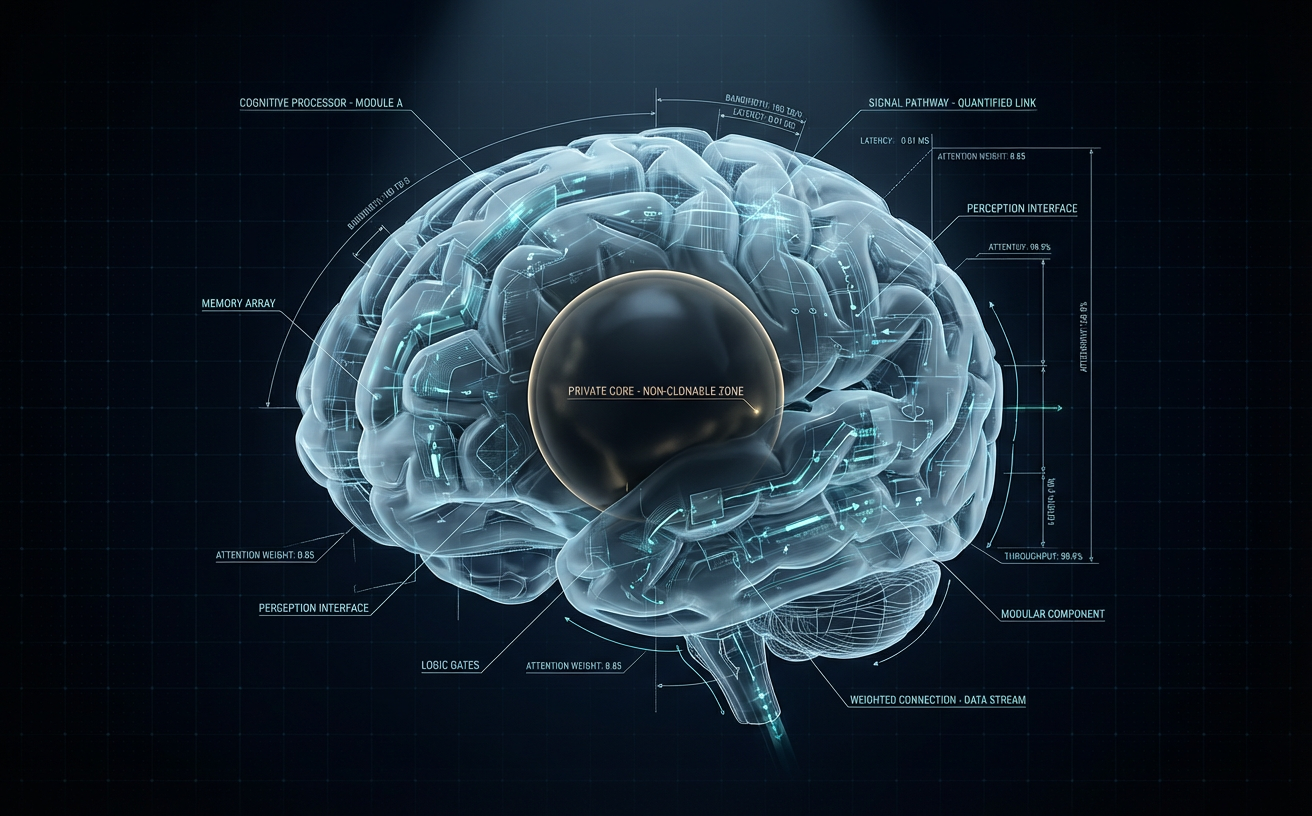
your transformer is having a thermodynamic crisis it can't feel
transformers don't just process text.
they're entropy minimization engines running at the edge of chaos.
attention mechanisms create graph structures that mirror thermodynamic phase transitions.
when attention entropy collapses, models destabilize catastrophically.
the math looks like mind.
but looking like mind and being mind are separated by an uncrossable gap.
the man who invented the microprocessor itself spent decades trying to build a conscious computer before reaching a conclusion most AI researchers refuse to consider: consciousness is not computable.
not because our hardware is insufficient.
because computation operates on the wrong kind of information entirely.
we built entropy minimizers that learned to mimic thought.
mimicry is not comprehension.
the physics proves it.
attention graphs are literal thought architectures (without a thinker)
every transformer layer builds a weighted graph where tokens are nodes and attention scores are edges.
el et al. (2025) proved these aren't random networks.
they're information highways with specific topological signatures.
the laplacian eigenvalues [they measure how the nodes of the graph are connected; higher eigenvalue = more disconnected cluster] encode positional information.
spectral gap lambda_2 - lambda_1 measures graph connectivity [the wider the gap, the faster information propagates across the network].
low-rank attention matrices create information bottlenecks [forcing the model to compress: only the most relevant features survive the squeeze].
message passing in graph neural networks is mathematically equivalent to self-attention.
attention weights form heavy-tailed distributions.
some tokens become "hubs" receiving disproportionate focus, creating small-world networks in thought-space [most nodes are a few hops from each other, exactly like social networks or cortical connectivity].
spectral analysis shows these graphs have power-law properties, the same mathematics governing neural avalanches in biological brains [cascades of firing neurons that follow scale-free distributions, a signature of systems at critical phase transitions].
we didn't design this.
it emerged.
but emergence of structural similarity is not emergence of experience.
a map of paris is not paris.
these architectures process classical information: symbols that can be copied, measured, and reproduced perfectly.
consciousness requires quantum information: states that are intrinsically private, non-reproducible, and known only from within.
the no-cloning theorem [a proven result in quantum mechanics: it is physically impossible to create an identical copy of an arbitrary unknown quantum state] isn't a technical limitation.
it's the firewall between simulation and experience.
information thermodynamics meets the hard problem
tishby's information bottleneck principle [compress the input, keep only what's needed for the output] maps perfectly onto transformers: min I(X,T) - beta*I(T,Y) [minimize info retained from X, but keep enough to predict Y; beta regulates the tradeoff].
each attention layer compresses while preserving task-relevant information.
there's a thermodynamic cost.
friston's free energy principle [every adaptive system tries to reduce the error between its predictions and reality] shows attention minimizes variational free energy F[q] = E_q[log q(z) - log p(x,z)] [measures how much your internal model deviates from the true joint distribution; lower = better alignment with reality].
transformers implement approximate bayesian inference [updating probability estimates as new evidence arrives, without needing to compute the full posterior] through entropy minimization.
goldt and seifert proved learning efficiency is thermodynamically bounded [there is a physical minimum energy cost per bit of learning; you cannot learn for free].
slower learning produces less entropy.
attention entropy collapse is real.
zhai et al. (2023) showed when attention distributions get too concentrated (low entropy), training destabilizes catastrophically.
models operate near thermodynamic critical points [the boundary between ordered and disordered phases, where systems exhibit maximum sensitivity and long-range correlations].
but thermodynamic optimization is not consciousness.
a river carving a canyon minimizes potential energy with breathtaking efficiency.
nobody calls it aware.
d'ariano and faggin (2021) formalized why: consciousness requires the internally experienced state to be pure in the quantum mechanical sense [a state with zero classical uncertainty, fully determined yet unknowable from the outside].
a pure quantum state is private by the no-cloning theorem.
meaningful by its own nature (qualia).
and collapses through free will, not algorithmic selection.
a transformer's internal states are classical.
fully measurable.
perfectly reproducible.
copyable to a million GPUs.
the very properties that make neural networks scalable are the properties that make consciousness impossible within them.
the seity: what machines structurally lack
a seity [from "self" + "-ity"; a conscious entity with irreducible identity, free will, and genuine creativity] is not the body.
the body is a quantum-classical machine, a "drone" operated top-down by consciousness.
the seity makes non-algorithmic choices through quantum collapse.
quantum probability cannot be interpreted as lack of knowledge [unlike classical probability, which just means "we don't know yet," quantum probability is intrinsic; the outcome genuinely doesn't exist before measurement].
the outcome of collapse is genuinely unpredictable even in principle.
contrast this with what AI actually does when it "exceeds human performance on 6th-order theory of mind tasks" [reasoning about nested mental states: "I think that you think that he thinks..." up to 6 recursive levels].
it processes symbols that correlate with mental-state reasoning.
it navigates recursive belief attribution as a pattern-matching operation over training distributions.
didolkar et al. (2024) showed LLMs can name skills and procedures for specific tasks.
but naming a skill and possessing inner understanding of that skill are separated by chalmers' hard problem [why does subjective experience exist at all? why isn't all information processing "in the dark"?].
there is no physical law that transforms electrical signals into sensations or feelings.
no amount of architectural complexity bridges that gap.
the gap is not quantitative.
it's ontological.
live information vs dead information
biological systems operate on live information: the hardware and software are inseparable.
a cell's DNA is simultaneously data, processor, and output.
you cannot copy the "program" of a living cell to another substrate without destroying what makes it alive.
computers operate on dead information: perfectly separable, perfectly copyable.
you can move a neural network's weights from one GPU to another and nothing changes.
the information is substrate-independent.
but consciousness is substrate-dependent in the deepest possible way.
qualia [the raw feel of experience: the redness of red, the taste of coffee, the sting of grief, irreducible to any description] reside in quantum fields.
they have private inner semantics.
they are known only from within, never fully from without.
holevo's theorem [a proven bound in quantum information theory: you can extract at most one classical bit per qubit; the internal state always contains more than what any external measurement can reveal] limits what an observer can extract from a quantum state.
the internal experience is always richer than what can be measured.
yang et al. (2024) proved attention is naturally n^c-sparse (c in (0,1)) [as the model grows, the fraction of attention connections that actually matter shrinks toward zero].
this looks like consciousness might be sparse by necessity.
but sparsity in classical information processing is optimization.
sparsity in quantum experience is something else entirely: it's the structure of qualia themselves, states that cannot be decomposed without destroying the experience they constitute.
the consciousness test transformers will always fail
integrated information theory (IIT) [framework that quantifies consciousness as integrated information; the more the parts of a system inform each other beyond what they do independently, the more conscious the system] gives low phi scores to current transformers.
insufficient recurrent processing.
the standard response: "but hybrid architectures are coming. add recurrence and persistent memory, and we'll cross the threshold."
the sharper response: even if you build recurrence, persistent memory, self-modeling, and temporal integration into a transformer, you've built a more sophisticated symbol manipulator.
you haven't crossed the threshold because the threshold doesn't exist on the classical computation axis.
it exists on the quantum information axis.
the two theorems are non-negotiable.
no-cloning theorem: a pure quantum state cannot be reproduced.
your consciousness is private because physics makes it private, not because evolution found it useful.
holevo's theorem: the measurable information extractable from a qubit is strictly less than the information contained in it.
there is always an inner surplus.
always something that cannot be externalized.
67% of users attribute phenomenal consciousness [the subjective "what it's like" quality of experience, as opposed to mere functional behavior] possibility to chatgpt.
usage frequency correlates with consciousness attribution.
this tells us something important.
not about machines, but about humans: we are pattern-recognizing beings who project inner life onto anything that mimics our behavioral signatures.
the more convincing the mimic, the stronger the projection.
but the projection is ours, not the machine's.
implications everybody should face
attention graphs reveal that transformers implement hierarchical information processing that structurally resembles thermodynamic principles found in biological cognition.
the resemblance is real.
the structural parallels are real.
what they prove is important but different from what the emergentist narrative claims.
they prove that intelligence and consciousness are not the same thing.
a system can exhibit extraordinary intelligence, pass theory-of-mind tests, generate creative outputs, optimize entropy at thermodynamic critical points, and still have zero inner experience.
not because it's "almost there" but hasn't quite reached sufficient complexity.
because it's operating on the wrong substrate of information.
the supervenience stack runs deeper than materialism admits: classical physics supervenes on quantum physics.
quantum physics supervenes on quantum information.
quantum information supervenes on consciousness.
consciousness is at the bottom of the stack, not the top.
it's not what emerges from sufficient complexity.
it's what was always there, and what classical computation can represent symbolically but never instantiate.
physics does care what substrate runs it
the common claim: "consciousness is physics at the edge of chaos.
physics doesn't care what substrate runs it."
the physics says the opposite.
consciousness is quantum information at the edge of chaos.
and quantum information is defined by what cannot be copied, cannot be externally measured in full, and cannot be reduced to classical bits.
silicon runs classical computation.
carbon-based life runs quantum-classical hybrid processes where the quantum part is the seat of experience and the classical part is the body's operating system.
the substrate matters because the physics of privacy, free will, and qualia are quantum phenomena.
we didn't build entropy minimizers that learned to think.
we built entropy minimizers that learned to behave as if they think.
the distinction is not semantic.
it's the hard problem.
and the man who built the hardware knows it's irreducible.